
Is Your Accounting Firm Invisible to AI Search?
A practical visibility audit for CPA, tax, and advisory firms
For years, accounting firms have treated online visibility as a Google problem. If the firm ranked for the right keywords, attracted organic traffic, and converted a portion of that traffic into consultations, the digital marketing system was considered healthy.
That view is now incomplete. Buyers still use Google, but they are also using AI tools to shortlist firms, compare providers, and understand complex accounting, tax, and advisory issues before they ever visit a website.
The risk is straightforward. Your firm may still appear in traditional search results while being largely absent from AI-generated answers that influence early-stage buyer decisions.
The Buyer Journey Has Changed
Prospective clients are not only searching for firms anymore. They are asking AI tools to interpret the market for them, explain their options, and recommend which providers deserve consideration.
The questions are usually practical and specific. They sound much closer to how a business owner, CFO, founder, or practice manager would actually think about a buying decision:
-
“Who are the best CPA firms for dental practices in Dallas?”
-
“Which accounting firms specialize in R&D tax credits for SaaS companies?”
-
“Compare Firm A and Firm B for outsourced CFO services.”
-
“Who are the top advisors for succession planning for family-owned businesses?”
-
“What should a manufacturing business look for in a fractional CFO?”
Those questions used to lead to a search results page filled with links. Today, they may lead to a summarized answer that mentions only a small number of firms, cites a handful of sources, and gives the buyer a strong impression before they click anything.
That is the AI visibility gap. Your firm can have a decent website, reasonable SEO, and useful content, while still being invisible when AI tools summarize the market for your ideal clients.
Why AI Visibility Matters for Accounting Firms
Accounting, tax, and advisory services are trust-based buying decisions. Prospects rarely choose a firm because of one blog post, one ad, or one isolated search result.
They choose a firm after seeing enough evidence that the firm understands their situation. They look for relevant expertise, practical experience, industry familiarity, and confidence that the firm can help them avoid mistakes or make better decisions.
AI tools are compressing that research process. Instead of visiting ten websites, a prospect can ask one question and receive a synthesized answer that summarizes providers, explains differences, and points to selected sources.
This matters because AI-generated answers are selective. They do not list every firm, and they do not cite every article. They elevate sources that appear clear, credible, current, and useful.
For accounting firms, this creates a new marketing requirement. Your digital presence must help AI systems understand who you are, what you do, who you serve, and why your firm deserves to be cited.
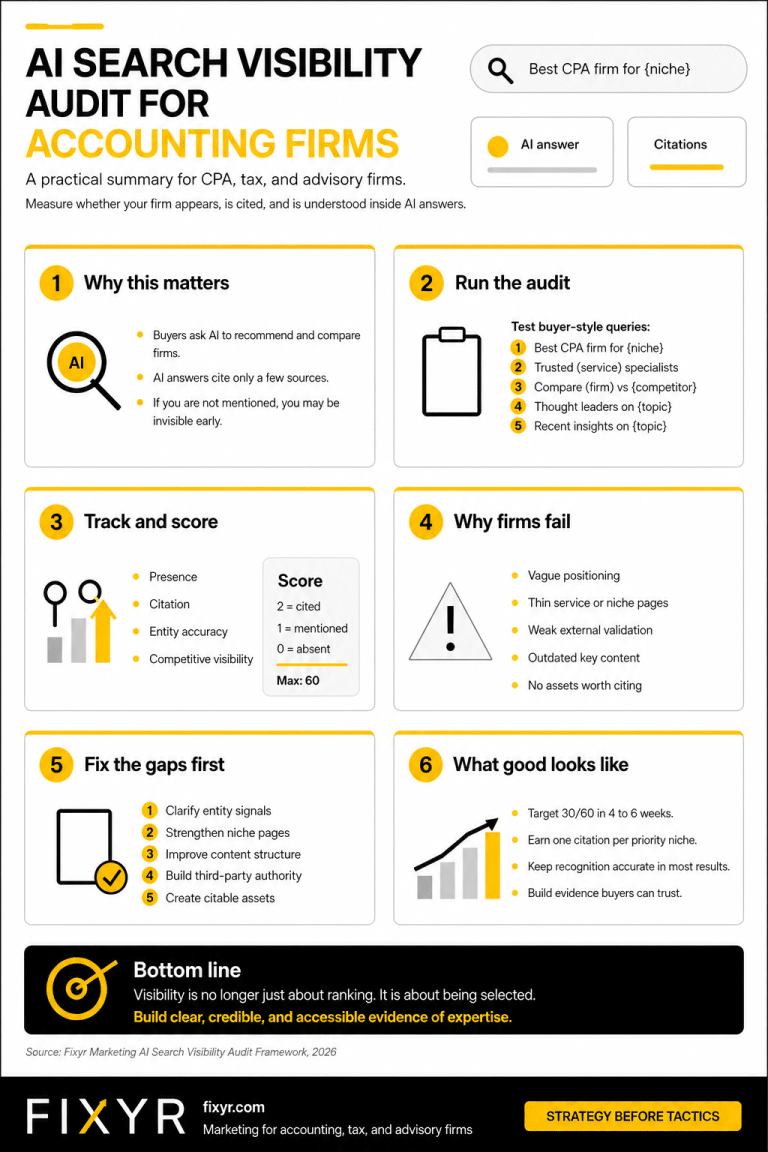
The 15-Minute AI Visibility Audit
The first step is not to chase another tactic. The first step is to establish a baseline, because you cannot fix a visibility problem until you know where it exists.
A simple AI visibility audit can give your firm a practical read on how well you are showing up. It takes 15 to 20 minutes, and it can reveal gaps that traditional SEO reporting will not show.
1. Start With Six Buyer Questions
Use prompts that reflect how your ideal clients actually evaluate providers. The goal is not to test vanity searches, but to understand whether your firm appears when buyers ask high-intent questions.
Run these six queries, customized to your services, niches, and geography:
-
Best CPA firm for {your niche} in {city}
-
Trusted {service} specialists for {industry}
-
Compare {your firm} vs {top competitor}
-
Top thought leaders on {topic you publish about}
-
Step-by-step: {service or process} for {ideal client profile}
-
Recent insights on {timely topic you cover}
These questions work because they test different types of visibility. Some measure category visibility, some measure competitive comparison, and some measure whether your content is strong enough to support education-based buyer research.
2. Run the Questions Across AI-Enabled Platforms
Do not test only one tool. Different platforms draw on different sources, format answers differently, and vary in how they cite websites.
At minimum, test the same six queries across:
-
ChatGPT
-
Claude
-
Perplexity
-
Microsoft Copilot
-
Google AI Overviews
The value is in comparison. If your firm appears in one platform but not others, that tells you something about where your signals are strong and where they are weak.
3. Track Four Practical Signals
The audit should be simple enough that a partner, marketing manager, or practice leader can run it without building a complicated dashboard. What matters is whether your firm is present, understood, and supported by credible source material.
For each query and each platform, record the following:
-
Presence: Does your firm appear at all?
-
Citation: Is your website linked or cited as a source?
-
Entity accuracy: Does the tool describe your firm correctly?
-
Competitive visibility: Which firms, directories, articles, or associations appear instead?
The fourth signal is often the most useful. When your firm is absent, the audit shows who or what is replacing you in the answer.
4. Score the Results
Keep the scoring simple. A practical scoring model makes it easier to compare progress over time without turning the audit into a large research project.
Use this framework:
-
2 points: Your firm is cited or linked.
-
1 point: Your firm is mentioned, but not cited.
-
0 points: Your firm is absent, misunderstood, or misattributed.
With six questions across five platforms, the maximum score is 60. Many firms will find that they score well only on branded searches, which means AI tools may recognize the firm name but do not yet recommend the firm for broader category or problem-based questions.
That distinction matters. Existing clients know your name, but future clients often start with a problem, a niche, a location, or a service need.
Why Most Firms Fail the Test
Most accounting firms do not fail this audit because they lack content. They fail because their digital presence is not structured in a way that makes the firm easy to understand, validate, and cite.
The issue is usually a combination of positioning, content quality, structure, and external authority. Each weakness reduces the likelihood that an AI tool will select the firm as a useful answer.
1. The Firm’s Positioning Is Too Generic
Many firms describe themselves using phrases such as trusted advisors, personalized service, full-service accounting, or business solutions. Those phrases may be accurate, but they are not specific enough to establish a clear market position.
AI systems need stronger signals. They need to understand whether you serve construction companies, dental practices, SaaS founders, manufacturers, professional practices, family-owned businesses, or high-net-worth individuals with complex tax needs.
Specificity does not limit your firm. It makes your expertise easier to recognize.
2. The Content Is Not Built to Be Cited
Many accounting firm websites contain useful information, but the best insights are often buried in long articles, thin service pages, or dated newsletters. That makes the content harder for both buyers and AI tools to evaluate.
Citable content is usually clear, structured, and specific. It answers a defined question, explains the issue in plain language, and gives the reader enough substance to trust the source.
Strong pages often include:
-
Clear headings
-
Concise summaries
-
Definitions of technical terms
-
Step-by-step explanations
-
FAQs based on real buyer questions
-
Examples tied to a specific industry or situation
The goal is not to make your content simplistic. The goal is to make your expertise easier to understand and reference.
3. The Firm Lacks External Validation
Your website matters, but your website alone is not enough. AI tools also look for signals that your firm is recognized beyond its own domain.
Third-party validation can come from many places, including:
-
Industry association listings
-
Accounting and advisory directories
-
Software partner pages
-
Podcast appearances
-
Webinar participation
-
Guest articles
-
Media quotes
-
Referral partner profiles
These signals help confirm that your expertise is not only claimed by your firm. It is recognized in the broader market.
4. Important Content Is Outdated
Accounting and advisory topics change. Tax rules change, incentive programs change, reporting expectations change, and buyer concerns shift over time.
If your most important service pages or technical articles have not been updated in years, they may lose ground to newer and clearer sources. A visible update date, revised examples, and refreshed guidance can materially improve the usefulness of a page.
Freshness alone will not compensate for weak content. However, current and well-structured content has a better chance of being selected than stale material on the same topic.
5. The Firm Has Not Created Distinctive Assets
Generic content is easy to overlook. Original assets give buyers, referral partners, and AI systems something more useful to reference.
Distinctive assets may include:
-
Benchmark reports
-
Industry-specific checklists
-
Pricing guides
-
Readiness assessments
-
Calculators
-
Annual tax planning updates
-
Implementation guides
These assets are useful because they move beyond opinion. They provide practical tools, structured insight, and evidence that your firm understands a specific client problem.
What to Fix First
Once you complete the audit, do not turn the findings into a random marketing to-do list. The firms that improve fastest are the ones that fix the highest-leverage gaps first.
At Fixyr, this is where strategy before tactics matters. More content is not always the answer, especially when the underlying positioning and authority signals are weak.
1. Strengthen Your Entity Signals
Start by making your firm easier to understand. This includes your website, directory profiles, leadership bios, and major third-party listings.
Focus on the basics first:
-
Firm name: Use consistent naming across platforms.
-
Locations: Make office locations and service areas clear.
-
Services: Describe services in specific, buyer-friendly language.
-
Industries: Identify the niches or client segments you serve best.
-
Leadership: Write bios that explain expertise, not only credentials.
-
About page: Make the firm’s positioning clear and substantive.
Entity clarity matters because AI tools need confidence before they include your firm in an answer. If your signals are inconsistent, vague, or incomplete, your firm becomes harder to classify.
2. Build Pages That Answer Buyer Questions
Take the six audit questions and compare them against your website. For each question, ask whether your firm has a strong page that deserves to be cited.
If you want to be found for outsourced CFO services for manufacturers, a generic CFO services page is unlikely to be enough. You need a page that explains the specific financial management issues manufacturers face, how your process works, what the engagement typically includes, and how a buyer should evaluate fit.
A strong buyer-focused page should answer:
-
Who is this service for?
-
What problem does it solve?
-
When does a client usually need it?
-
What does the process look like?
-
What information or documents are required?
-
What outcomes should the client expect?
-
How should a buyer evaluate providers?
This structure serves both human readers and AI systems. It makes the page more useful, more complete, and easier to reference.
3. Improve the Structure of Existing Content
You may not need to create everything from scratch. In many cases, your best opportunity is to improve the structure of content you already have.
Look for pages that cover important services, industries, or recurring client questions. Then improve them by adding:
-
A short executive summary near the top
-
Clear section headings
-
Definitions where technical terms are used
-
Practical examples
-
Numbered steps
-
FAQs
-
Internal links to related services and articles
-
A visible last-updated date
This is not cosmetic editing. Better structure improves comprehension, strengthens buyer confidence, and makes your content easier to extract and cite.
4. Build External Authority
Next, review where your firm appears outside its own website. This is often one of the fastest ways to improve credibility signals.
Start with sources that already exist but may be incomplete or inconsistent:
-
Professional association profiles
-
Local business directories
-
Niche industry directories
-
Software partner listings
-
Referral partner websites
-
Speaker profiles
-
Podcast or webinar pages
Then look for new authority-building opportunities. A well-placed podcast appearance, guest article, webinar, or industry quote can support both referral visibility and AI visibility.
The objective is not to collect random backlinks. The objective is to create credible, relevant, and consistent evidence that your firm belongs in the conversation.
5. Create Assets Worth Citing
Once the basics are in place, invest in content that is genuinely useful. The best assets are the ones a prospect would save, share, or use in a decision-making process.
For accounting firms, high-value assets often include:
-
“2026 Tax Planning Checklist for Dental Practices”
-
“R&D Credit Readiness Guide for SaaS Companies”
-
“Outsourced CFO Evaluation Scorecard for Manufacturers”
-
“Succession Planning Checklist for Family-Owned Businesses”
-
“Monthly Close Improvement Guide for Growing Companies”
These assets work because they connect expertise to a specific buyer problem. They also create stronger source material than a general article on a broad topic.
What Good Looks Like
A practical near-term target is a score of 30 out of 60 within four to six weeks for your priority services or niches. That does not mean your firm will dominate every AI-generated answer, but it does mean you are beginning to appear in the places where relevant prospects are asking questions.
You should also aim for at least one citation across each priority service or niche. If your firm wants to grow in outsourced CFO services, R&D tax credits, estate planning, and dental practice accounting, each of those areas should have at least one strong page or asset that can reasonably earn citations.
Accuracy matters as much as presence. If AI tools confuse your services, misstate your location, ignore your niche, or mix you up with another firm, you have an entity clarity problem that needs to be corrected before you expect stronger visibility.
The Bigger Strategic Issue
The AI visibility gap is not really about AI. It is about whether your firm has created enough clear, credible, and accessible evidence to be selected by a buyer.
AI tools simply expose weak marketing foundations faster. If your positioning is generic, your firm will be treated as generic, and if your content is thin, it will be overlooked in favor of stronger sources.
This is why the answer is not simply publish more content or add AI to your SEO strategy. The better answer is more disciplined and more strategic.
Focus on the fundamentals:
-
Clarify your market position.
-
Strengthen your service and niche pages.
-
Answer real buyer questions.
-
Structure content so it can be understood and cited.
-
Build third-party authority.
-
Keep important content current.
-
Create assets that buyers and AI tools can reference.
That is how firms build durable visibility. It is also how they make themselves easier for prospects to find, evaluate, and choose.
The Bottom Line
Accounting firms are entering a new phase of digital competition. The firms that win will not necessarily be the ones producing the most content, but the ones producing the clearest, most useful, and most credible evidence of expertise.
Traditional search still matters, and so do referrals, websites, and professional reputation. The difference is that AI-generated answers are becoming part of the buyer’s decision process, which means firms need to understand how visible they are inside those answers.
Run the audit for one core service and one priority niche. The results will show where your firm appears, where it is absent, and who is being cited instead.
Then fix the gaps in the right order. Not with more random marketing activity, but with a focused plan that makes your firm easier to find, easier to understand, and easier to choose.