Your next accounting lead may not start with a Google search. It may start with a business owner asking ChatGPT a question they are not ready to ask you yet.
- “Do I need a bookkeeper or a CPA?”
- “Why am I profitable but still short on cash?”
- “What should I ask before hiring a tax advisor?”
- “When does my business need a fractional CFO?”
Those are not random prompts. They are potential buying signals.
That is why ChatGPT Ads matter for accounting, bookkeeping, tax, and advisory firms. Not because they are new. Not because AI is the current marketing trend. They matter because they may create paid visibility while a prospect is actively thinking through a problem your firm solves.
The practical answer is simple: pay attention early, but do not rush in without a strategy.
ChatGPT Ads may become a useful lead generation channel. They may also become another place for firms to waste money. The difference will come down to audience, positioning, offer, landing page, tracking, and follow-up.
What are ChatGPT Ads?
ChatGPT Ads are sponsored placements that can appear inside eligible ChatGPT conversations. OpenAI says ads may appear below relevant conversations, and the ad format can include the advertiser name, logo, headline, description, landing page, and image creative. [2]
That placement is important. These are not traditional banner ads sitting beside an article. They show up in the context of a conversation.
A business owner might ask ChatGPT how to choose a bookkeeper, prepare for tax season, clean up QuickBooks, improve financial reporting, or decide whether they need fractional CFO support. Those questions often happen before the prospect searches Google, asks for a referral, or visits a firm website.
For accounting firms, that creates a new lead generation question: can your firm appear near the right conversation, with the right offer, at the right moment?
One major limitation: ads do not run on Plus or Pro
This needs to be clear before any firm treats ChatGPT Ads as a serious lead generation channel.
OpenAI currently says ads may appear for Free and Go users. OpenAI also says Plus, Pro, Business, Enterprise, and Education plans do not have ads. [1] [5]
That means ChatGPT Ads do not reach every ChatGPT user. They reach the ad-supported audience, and availability can vary by country as OpenAI continues expanding the program.
For accounting firms, this matters. If your ideal clients are heavy paid ChatGPT users on Plus, Pro, Business, Enterprise, or Education plans, ChatGPT Ads may not reach them today. If your ideal clients include business owners, managers, entrepreneurs, and individuals using Free or Go plans, the channel may be more relevant.
This does not make ChatGPT Ads good or bad. It means firms need to understand who they can actually reach before building a lead generation plan around the platform.
Ads do not influence ChatGPT’s answers
OpenAI says ads do not influence ChatGPT’s answers. OpenAI also says ads are separate from the response and clearly labeled. [1] [5]
This distinction matters.
Your firm is not paying to become the answer. You are not buying a recommendation from ChatGPT. You are buying a sponsored opportunity to appear near eligible conversations.
That is a very different strategy than AEO.
How paid ChatGPT Ads fit with AEO
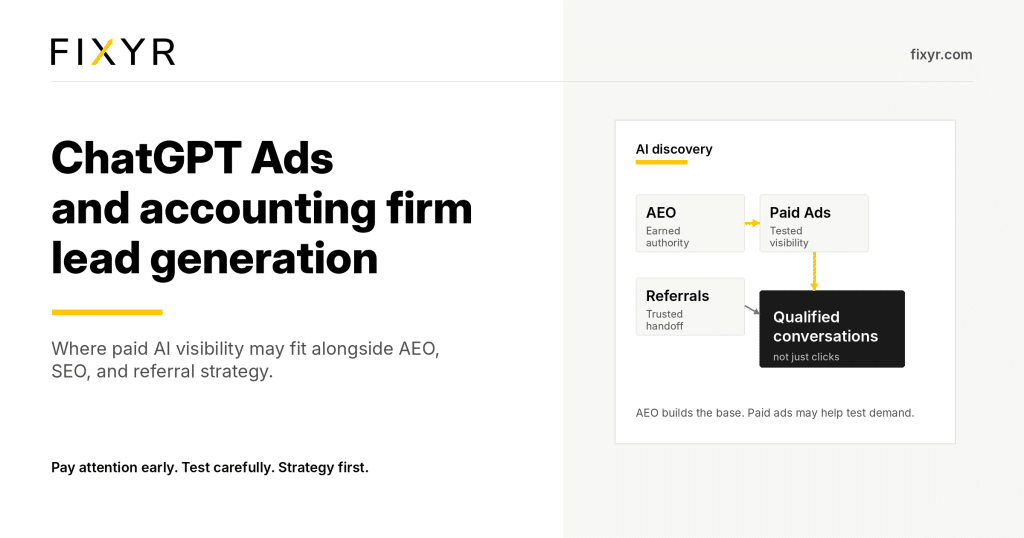
AEO = Answer Engine Optimization, which is how you earn visibility in AI-assisted answers. It is the long-term work of making your firm easier for AI tools to understand, trust, reference, and surface when prospects ask relevant questions.
Paid ChatGPT Ads are different. They do not put your firm inside the answer. They may place a sponsored ad near an eligible conversation.
That means paid advertising is not a replacement for AEO. It is also not a shortcut around authority, reputation, or expertise.
The better way to think about it is this:
- AEO helps you earn visibility over time.
- Paid ChatGPT Ads may help you test visibility sooner.
- AEO helps build long-term authority around the problems your firm solves.
- Paid ChatGPT Ads may help test which problems, offers, and service lines generate interest.
- AEO can support your organic discovery strategy.
- Paid advertising can support specific campaigns, niches, or lead generation offers.
For some firms, paid ChatGPT Ads may be a supplement to AEO. For others, they may be an alternative test while the firm is building its AEO foundation. But the two should not be confused.
If your accounting firm wants AI visibility, you still need useful content, clear service pages, strong positioning, proof, and reputation signals. Paid ads can only work well when the rest of the system is strong.
How ChatGPT advertising works
ChatGPT Ads are more context-driven than traditional search ads. In Google Ads, a firm may target keywords like “CPA near me,” “bookkeeping services,” or “tax planning for small business.”
In ChatGPT Ads, OpenAI says ad selection is based primarily on relevance to the context and intent of the conversation. Advertisers can provide context hints, but those hints are not exact-match keywords and do not guarantee that an ad will appear in a specific conversation. [2]
That changes the planning process.
Instead of starting with keywords, firms need to start with the questions and problems that show buying intent.
For example:
- A business owner trying to understand why cash flow is tight
- A founder comparing outsourced bookkeeping and in-house finance support
- A professional services firm preparing for tax season
- A growing company asking when to move from bookkeeping to advisory
- A nonprofit trying to improve financial reporting
These are not just content topics. They are potential lead generation moments.
OpenAI’s Ads Manager Beta supports campaign creation, ad creation, performance monitoring, billing, permissions, and reporting. The current advertiser documentation also describes CPC and CPM buying options, along with reporting for impressions, clicks, spend, click-through rate, average CPC, average CPM, and conversions. [2] [3]
Those metrics are useful, but they are only the starting point. Accounting firms should measure the business outcome, not just the platform activity.
Why this matters for lead generation
Lead generation for accounting firms is not about getting more random clicks. It is about creating more qualified conversations with the right prospects.
A firm does not need hundreds of poor-fit inquiries from people looking for free advice, the cheapest tax return, or one-off bookkeeping help. A firm needs the right prospects. That might mean growing businesses, niche industry clients, owner-managed companies, incorporated professionals, nonprofits, contractors, medical practices, or professional services firms.
ChatGPT Ads may be useful because they can appear near conversations that show intent.
A prospect may ask:
- “How do I know if I need a bookkeeper?”
- “What should I ask before hiring a CPA?”
- “Why is my business profitable but always short on cash?”
- “When should I hire a fractional CFO?”
- “How do I prepare my books before tax season?”
- “What financial reports should I review each month?”
A firm that understands those moments can build better campaigns. A firm that runs generic ad copy like “trusted accounting services” will likely waste money.
The better campaign connects the conversation to a clear next step.
Where ChatGPT Ads may fit for accounting and advisory firms
ChatGPT Ads may be most useful when the firm has a specific audience, specific problem, and specific offer.
Bookkeeping
Bookkeeping may be one of the more natural use cases if the offer is clear. Many business owners know their books are messy before they know what service they need.
They may ask about QuickBooks cleanup, month-end close, categorization problems, unreliable reports, cash flow confusion, or whether they need in-house or outsourced bookkeeping.
A weak campaign says, “We do bookkeeping.”
A stronger campaign says, “Clean up your books before year-end” or “Monthly bookkeeping for growing service businesses.”
The landing page should match the offer. If the ad is about QuickBooks cleanup, do not send people to a generic homepage.
Tax
Tax may be relevant, but it needs more caution.
People use ChatGPT to understand tax deadlines, forms, deductions, entity structure, cross-border questions, and what to ask a tax professional. That creates clear moments of need.
But tax-related advertising can move quickly into regulated, high-stakes, or sensitive territory. Avoid exaggerated savings claims. Avoid guaranteed outcomes. Avoid copy that looks like individualized tax advice inside the ad.
A safer campaign angle may focus on education, planning, or consultation:
- Small business tax preparation support
- Year-round tax planning for business owners
- Tax help for incorporated professionals
The key is to verify eligibility before launching.
Advisory and fractional CFO
Advisory can be a strong fit if the firm has a clear niche.
Many business owners do not search for “CAS” or “client advisory services.” They ask questions like:
- “Why am I profitable but short on cash?”
- “How do I know if I can afford to hire?”
- “What financial reports should I review every month?”
- “When do I need a fractional CFO?”
Those questions show pain and intent. A strong advisory campaign should connect that intent to a clear offer.
For example:
- Cash flow advisory for growing contractors
- Fractional CFO support for professional services firms
- Financial reporting and planning for multi-location businesses
The more specific the audience and offer, the easier it is to align the ad, landing page, and follow-up process.
Niche accounting firms
Niche firms may have an advantage.
A general firm saying “full-service accounting firm” may struggle to stand out. A firm focused on dentists, trades, ecommerce, real estate investors, nonprofits, medical practices, or professional services firms can build more relevant messaging.
Specificity matters in lead generation. It also matters in AEO. AI-driven discovery tends to reward clear expertise, not vague positioning.
The policy and eligibility issue
Accounting, tax, and advisory firms need to be careful with eligibility.
OpenAI’s current user-facing ad help says advertisers in sensitive or regulated verticals such as financial services are excluded from advertising on ChatGPT at this time. [1] OpenAI’s ad policies also say ads for financial products and services are restricted, and that approved financial advertisers may be allowed in some circumstances. [4]
The practical takeaway is not to guess.
Before building a campaign, review:
- The service category
- The ad copy
- The landing page
- The offer
- The claims being made
- Any disclaimers needed
- The current OpenAI approval requirements
A bookkeeping cleanup offer may be reviewed differently than a financial services offer. A tax planning campaign may be reviewed differently than a general educational resource. An advisory campaign may raise different questions depending on the promise, landing page, and claims.
This is not a reason to ignore the channel. It is a reason to approach it properly.
What a good ChatGPT Ads lead generation campaign might look like
A good campaign should connect the user’s question to a clear next step.
Example 1: Bookkeeping firm
User intent: A business owner is trying to understand why their books are messy or unreliable.
Ad angle: Clean up your books before year-end.
Offer: QuickBooks cleanup assessment.
Landing page: A page explaining who the service is for, common cleanup issues, what the assessment includes, and how to book a call.
Goal: Qualified bookkeeping consultation.
Example 2: Tax firm
User intent: A business owner is trying to understand whether they need year-round tax planning.
Ad angle: Year-round tax planning for owner-managed businesses.
Offer: Tax planning review.
Landing page: A page focused on tax planning, not a generic tax services page.
Goal: Qualified tax planning inquiry.
Example 3: Advisory or fractional CFO firm
User intent: A business owner is trying to understand cash flow, hiring capacity, profitability, or financial reporting.
Ad angle: Get better financial visibility before your next major business decision.
Offer: Cash flow or financial reporting assessment.
Landing page: A page explaining the business problem, who the service fits, and what happens on the first call.
Goal: Qualified advisory conversation.
The pattern is simple. Match the conversation. Match the problem. Match the offer. Track the lead.
What to do before testing ChatGPT Ads
Do not start with the ad platform. Start with the business problem.
1. Define the exact client you want more of
“Small businesses” is too broad.
Better examples include:
- Incorporated consultants earning over $250,000
- Trades businesses with 10 to 50 employees
- Dentists buying or growing a practice
- Ecommerce companies struggling with inventory and sales tax
- Nonprofits needing stronger reporting
- Professional services firms needing monthly financial insight
The more clearly you define the client, the easier the ad strategy becomes.
2. Identify the problem they are trying to solve
People do not wake up wanting an accounting firm. They want a problem solved.
They want clean books. Fewer surprises. Better cash flow. A tax plan. Confidence in hiring. Support during growth. Help understanding the numbers.
Your campaign should match the problem in the prospect’s words.
3. Build a specific offer
Do not send ChatGPT Ads traffic to a vague homepage.
Build an offer that fits the conversation.
Examples include:
- QuickBooks cleanup assessment
- Monthly bookkeeping consultation
- Tax planning review
- Fractional CFO discovery call
- Cash flow advisory assessment
- Year-end readiness check
The offer should make the next step obvious.
4. Use a landing page that matches the intent
This is where many firms will waste money.
If the ad is about QuickBooks cleanup, the landing page should be about QuickBooks cleanup. If the ad is about cash flow advisory, the landing page should be about cash flow advisory.
Your landing page should explain:
- Who you help
- What problem you solve
- What makes your firm credible
- What happens next
- Why the prospect should act now
- How to contact you
The ad platform will not fix a weak landing page.
5. Track the lead from click to client
Do not test ChatGPT Ads without tracking.
At minimum, track:
- Spend
- Clicks
- Landing page visits
- Form submissions
- Booked calls
- Qualified leads
- New clients
- Revenue from new clients
- Source quality
Clicks are not the goal. Qualified conversations are the goal.
How to measure ChatGPT Ads as a lead generation channel
The wrong scorecard is impressions and clicks.
The better scorecard is business quality.
For accounting firms, measure:
- Cost per qualified inquiry
- Cost per booked call
- Lead-to-client conversion rate
- Average client value
- Service line fit
- Source quality
- Time to close
- Revenue from new clients
- Client lifetime value
A cheap lead that will never become a good client is not a win. A higher-cost lead that becomes a strong monthly bookkeeping, tax planning, or advisory relationship may be worth far more.
That is the discipline firms need before testing any new paid channel.
Mistakes to avoid
The biggest mistake is treating ChatGPT Ads like another shiny tactic.
Watch for these issues:
- Running ads before fixing your positioning
- Using generic copy
- Sending traffic to your homepage
- Ignoring policy and eligibility risk
- Testing too small to learn anything
- Measuring clicks instead of qualified leads
- Cutting AEO or SEO work to chase a new ad channel
- Expecting paid ads to create trust that the firm has not earned
New channels do not create good marketing. They expose the quality of the system behind them.
Should your firm test ChatGPT Ads now?
You may be ready to test if:
- You know your ideal client
- You have a clear niche or service focus
- You have a specific offer
- You have a strong landing page
- You can track leads properly
- You have budget for a controlled test
- You are comfortable learning while the platform evolves
- Your offer is eligible under current OpenAI policies
You should probably wait if:
- Your website is weak
- Your message is generic
- You cannot explain your differentiation
- You do not have lead tracking in place
- Your firm is already overwhelmed with poor-fit inquiries
- Your offer may fall into a restricted or sensitive category
- You are hoping the platform will fix a strategy problem
That last point is the most important.
ChatGPT Ads may become an important paid advertising channel. But they will not fix unclear positioning, weak messaging, poor follow-up, or a bad offer.
Final recommendation
Pay attention early, but do not rush in blindly.
ChatGPT Ads may become a useful lead generation channel for accounting, bookkeeping, tax, and advisory firms. The opportunity is strongest when your firm has a clear ideal client, a specific service offer, a strong landing page, and a follow-up process that can turn interest into qualified conversations.
AEO still matters. SEO still matters. Referrals still matter. Reputation still matters.
Paid ChatGPT Ads may become a useful supplement to those efforts. They may help test demand, support priority services, and create visibility near relevant decision moments. But they are not a replacement for strategy.
Before testing, ask:
- Who exactly are we trying to attract?
- What problem are they trying to solve?
- What offer would make sense in that moment?
- Is our landing page strong enough to convert?
- Can we track the lead from click to client?
- Are our services and claims eligible under OpenAI’s current ad policies?
My view: test only if the lead generation system is ready.
Otherwise, fix the system first.
Is ChatGPT advertising for you? Contact us to find out more.
Source references:
[1] OpenAI Help Center. “Ads in ChatGPT.”
[2] OpenAI Help Center. “Ads in ChatGPT: The Basics.”
[3] OpenAI Help Center. “Create Campaigns for ChatGPT” and “Measure Results.”
[4] OpenAI. “Ad Policies.”
[5] OpenAI. “ChatGPT Privacy Settings.”