Your Firm’s AI Investment Isn’t Failing. Your Incentive System Is.
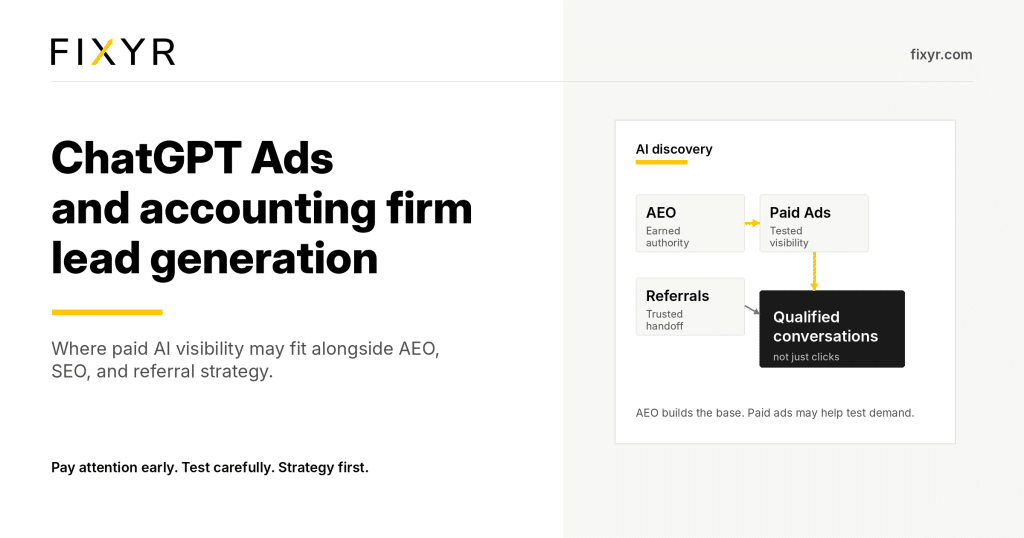
ChatGPT Ads may become a new lead generation channel for accounting, bookkeeping, tax, and advisory firms. Here is how they…
Read more →


Local search remains the most underrated marketing channel in professional services. For most independent accounting firms, it drives more qualified inquiries than LinkedIn, paid search, and email combined. Yet it is also the channel where Fixyr sees the most basic work left undone.
This article was originally published in 2024. A great deal has changed since, so this is the 2026 version.
Quick Answer: Local SEO for accounting firms in 2026 rests on three pillars. A complete and active Google Business Profile. Consistent citations and reviews across the web. And locally relevant content on your website that signals genuine geographic expertise. Firms that nail all three tend to dominate the “accountant near me” and “CPA in [city]” results within a twelve-mile radius.
Three shifts worth knowing about:
Google’s local pack is now more aggressive in surfacing Google Business Profiles with recent activity. A GBP that has not been posted to in six months is being pushed down in favor of firms that post, answer questions, and reply to reviews weekly.
Reviews have become a ranking factor that compounds. Firms with 50-plus reviews, responses on every review, and a steady inflow of new reviews are outranking firms with higher star averages but lower activity.
AI-generated local summaries now appear on many local queries. These summaries pull from GBP, the firm’s website, and third-party directories. Firms with consistent entity information across all three are being cited. Firms with conflicting information are being skipped.

Most CPA firms have a Google Business Profile. Most do not have a good one. The difference:
All categories filled, with the primary category as specific as possible. “Certified public accountant” outperforms “Accounting firm” for intent-matched searches.
Complete services list with individual descriptions, not generic labels.
Business hours, holiday hours, and service areas current.
At least 20 high-quality photos, including the team, the office, and visual elements from client work where appropriate.
Weekly posts with updates, insights, or links to new articles.
Responses to every review, positive and negative, within 48 hours.
Q&A section populated with your own answers to common questions before prospects ask.
Firms that get reviews have built a system for getting them. A simple post-engagement email sequence that asks for a review, a direct link to the Google review form, and a process for following up on silence. Partners and managers should not be improvising this one interaction at a time.
Do not buy reviews. Do not incentivize them. Google and the FTC are both more aggressive on this than they were two years ago, and the penalties are disproportionate to the gain.
Generic blog posts do not help local SEO. Locally relevant content does. A post titled “Year-End Tax Planning for Calgary Small Business Owners” signals geographic expertise in a way “Year-End Tax Planning Tips” never will.
Two or three genuinely local pieces per year, tightly written and linked from your homepage, often outperform twelve generic posts. The point is not volume. It is demonstrated local expertise in a form Google and AI engines can both recognize.
Your firm name, address, and phone number must be identical across your website, your Google Business Profile, your LinkedIn page, industry directories, and local chambers of commerce. Even small inconsistencies, such as “Suite 300” on one and “Ste. 300” on another, can fragment your local authority.
Audit your citations twice a year. Standard local SEO tools make the work tolerable.
Buying local directory listings on sites no one uses. Running Google Ads instead of fixing organic local first. Asking for five-star reviews from every client regardless of experience. None of these build durable local authority.
Local SEO is a tactical layer. It works best inside a clear positioning strategy, which is where most firms actually struggle. If your firm has not decided who it serves and what it wants to be known for, local SEO will make you findable but not preferred.
If you are not sure where your local footprint stands today, request a free SEO and Google Business Profile audit from Fixyr. We will tell you what is working, what is leaking, and what is worth your attention first.

Visible movement in the local pack usually takes 60 to 90 days of consistent activity. Meaningful inquiry flow takes four to six months.
Yes, if you have multiple physical offices. Each location needs its own page, its own Google Business Profile, and locally relevant content.
For accounting firms serving older demographics or enterprise clients, yes. Bing’s share of desktop search for professional services is meaningfully higher than its overall share.